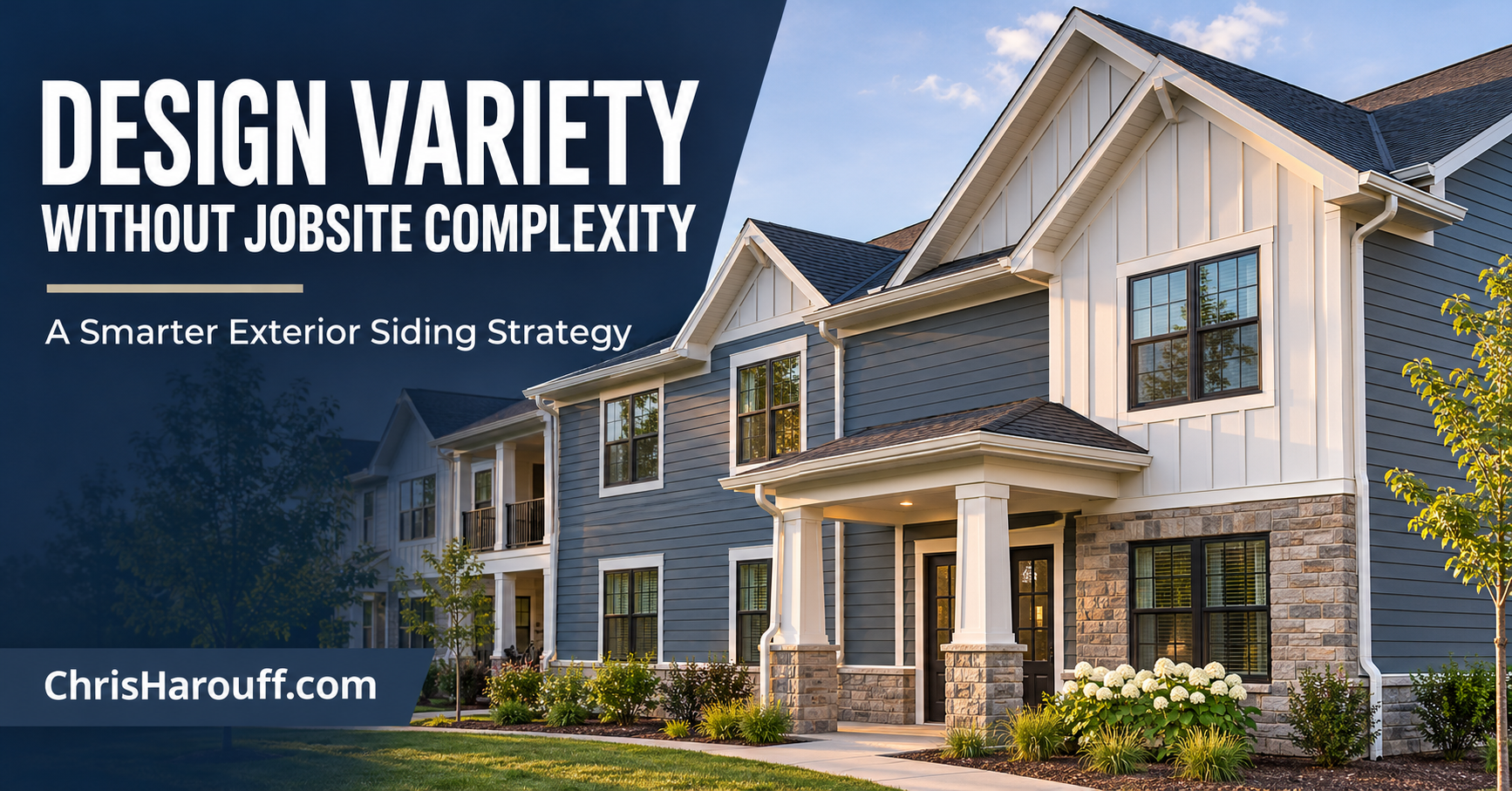
Architects and builders want enough exterior variety to create distinctive projects. Dealers, estimators and installers need enough consistency to purchase, stage and install those materials efficiently.
The strongest exterior programs accomplish both.
Rather than choosing every elevation independently, a project team can build a coordinated material palette using a limited number of siding profiles, colors and accents. Exterior Portfolio® provides horizontal lap, Dutch lap, beaded and vertical board-and-batten options, along with several soffit configurations. That range can support traditional, transitional and contemporary designs without requiring an entirely different material system for every architectural style.
Begin With a Repeatable Design Framework
For custom homes, the framework might consist of a primary horizontal siding, a contrasting gable or entrance accent and coordinated trim. On multifamily and production projects, the same approach can distinguish buildings, units or neighborhood phases while keeping the core product package manageable.
A practical palette could include:
- One primary horizontal profile
- One vertical or specialty accent
- Two or three coordinated body colors
- One consistent trim color
- A defined soffit and accessory package
- Approved transition details for stone, brick and other claddings
The objective is controlled variety. Changing one or two elements can give each elevation its own personality while preserving installation familiarity and purchasing efficiency.
Use Profiles to Reinforce the Architecture
Different siding profiles should have a reason for being on the elevation.
Horizontal lap siding can visually widen a structure and provide a familiar residential scale. Vertical board-and-batten can emphasize height or draw attention to gables, entrances and projecting volumes. Beaded or Dutch-lap profiles can contribute additional shadow lines and traditional character.
Exterior Portfolio’s current lineup includes Market Square®, Premium Pointe®, Carolina Sands®, Parkview®, Elm Grove™ and Board & Batten profiles. Exact colors, profiles and regional availability should be verified during product selection.
Premium Pointe is currently offered in 12- and 16-foot panel lengths, with the longer option intended to reduce visible seams on suitable wall dimensions. Longer panels may support a cleaner appearance, but estimating, transportation, staging and crew handling should all be considered before specifying them.
Treat Color as a Building-System Decision
Color affects more than curb appeal. It also influences accessory selection, replacement-material planning and consistency across phases.
Before approving the final palette, confirm:
- Which profiles are available in each selected color
- Whether trim and accessories provide the intended contrast
- How colors appear in direct sun and shade
- Whether multiple production lots may be involved
- How future phases or replacement materials will be handled
Digital visualizers can help narrow the options, but physical samples and an installed mockup remain important. Printed and online colors may vary from the finished product.
Installation Is Part of Product Performance
Vinyl siding is designed to move as temperatures change. It should not be fastened so tightly that the panels cannot expand and contract.
Published installation guidance calls for centering fasteners in the slots, avoiding overdriven fasteners and maintaining the required clearances within receiving channels. Vertical siding requires its own fastening and substrate considerations. Installers should always follow current manufacturer instructions and applicable building codes for the specific product and wall assembly.
A preinstallation meeting should address:
- Wall preparation and nailable substrate
- Water-resistive barrier and flashing integration
- Fastener type, length and spacing
- Panel movement and required clearances
- Joint and seam placement
- Vertical-to-horizontal transitions
- Trim, utility blocks and penetrations
- Product storage and jobsite handling
These details are especially valuable on multifamily projects, where a small installation inconsistency can be repeated across several buildings before anyone recognizes it.
Evaluate Installed and Lifecycle Value
Material price is only one component of exterior value. A complete comparison should also consider labor, painting requirements, accessory packages, maintenance expectations, warranty terms, replacement planning and the likelihood of callbacks.
Any project-specific performance, sustainability or warranty statement should be confirmed using current product documentation rather than applied broadly across the entire portfolio.
Connect Design, Distribution and Installation
Product brochures, color guides, installation information, technical documents, warranties, code-related materials, CAD resources and three-part specifications are most valuable when connected to local availability and the people actually building the project.
My role is to help bring architects, builders, developers, dealers and installers into that conversation early—supporting samples, specifications, product selection, installation training and project coordination.
Build a coordinated exterior program.
If you are developing a custom-home, multifamily or production-building exterior, let’s create a siding palette that delivers meaningful design variety while remaining practical to source and install.
Discuss your project →